
Stafford County Deed Records Explain Instruments
Stafford County land instruments go to the Circuit Court Clerk. Virginia adds a statewide service called Secure Remote Access to Land Records, or SRA. Not every recorded paper is a sale. A deed can convey land. Other instruments change, secure, correct, or release an interest instead. Broad labels tell you little. The title, parties, recording date, parcel data, and legal description do the real work. They tell filings apart. Stafford's local rules capture those details. The statewide cover sheet does too, which keeps a correction from being mistaken for a conveyance.
| Instrument | What It Records | Search Clue |
|---|---|---|
| Deed | Conveys an interest in land to a grantee | Compare parties, legal description, and prior deed reference |
| Deed of correction | Corrects information in a prior recorded deed | Search the related parties and earlier instrument |
| Deed of trust | Records a security interest tied to a loan | Look for a later release or satisfaction |
| Release or satisfaction | Records a later action on an earlier encumbrance | Match the lender, borrower, and referenced filing |
| Record plat | Sets out subdivision lots and land descriptions | Match subdivision, section, lot, and map number |
A deed and a deed of trust differ. One transfers an interest in land. The other records a security interest against it. A deed-of-trust entry alone will not show whether the loan was paid, so search Stafford County records separately for its release or satisfaction. Deed records prove what reached the clerk's books, but a recorded instrument is not by itself a full title opinion.
Stafford SRA Separates Index from Image
SRA is statewide, not a Stafford-branded deed site. Its access page explains the split. Free index-only searching depends on whether a circuit clerk enables it. Images work differently. Each clerk controls document images, and viewing them may require a signed subscriber agreement and payment. Whether Stafford's index is open without charge, the online cutoff year, and the exact image and copy fees are details to confirm with the clerk. A complete online chain is not guaranteed either.
Search both grantor and grantee names. One party's role flips from transfer to transfer. Record the instrument number or book and page, the date, the party names, and the legal description. When the index gives a reference without an image, use that reference to ask the Land Records Division for a copy. Similar names are common, so compare the parcel and legal description before following any match.
The Virginia SRA access page describes the index-versus-image model for Stafford land records.
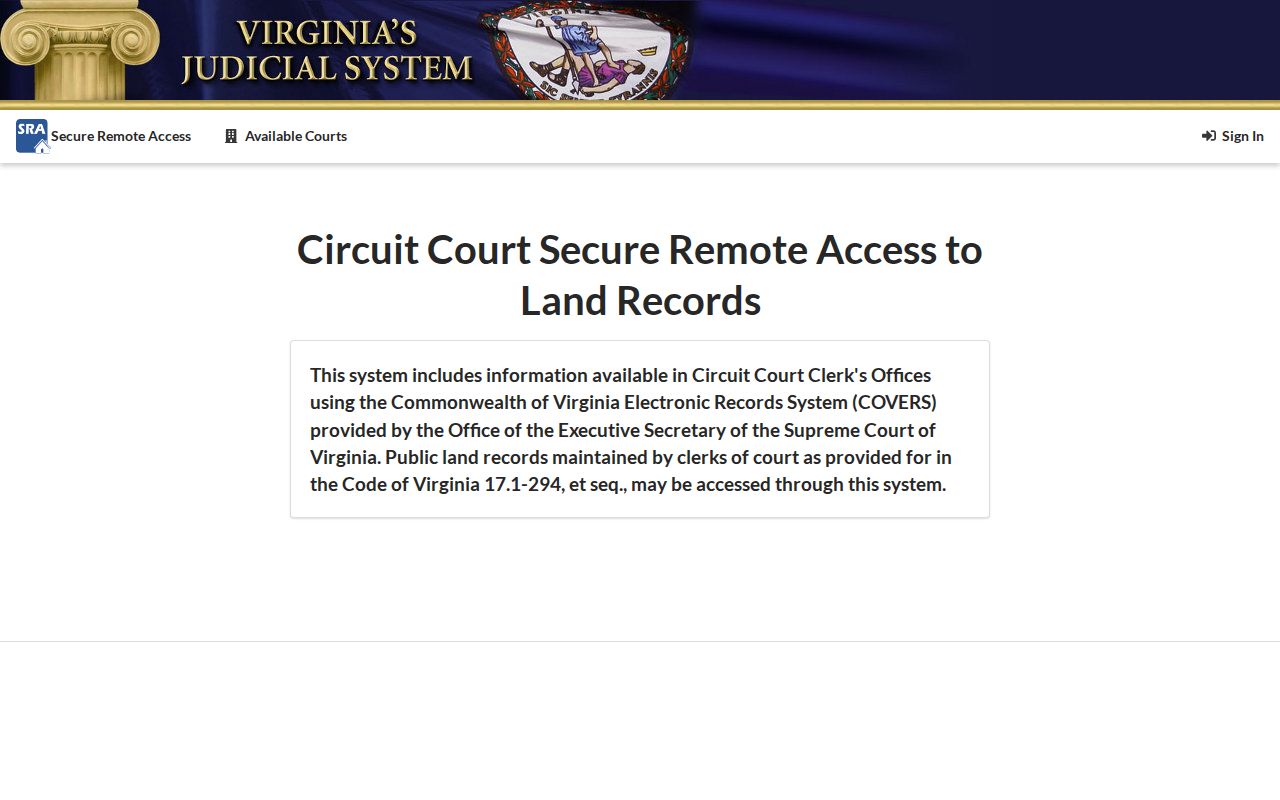
This is the statewide SRA entry point. Stafford-specific availability comes from the Circuit Court Clerk.
A Stafford Cover Sheet Captures Parties
Virginia's cover-sheet generator is configured for Stafford County Circuit Court, walking filers through Content, Grantors, Grantees, Parcels, and Review/Print. The state form is dense. It captures party names, consideration, actual value, exemptions, tax-map numbers, and page count. Stafford adds local requirements. The local recording rules call for a current grantee address, assessed value, and trustee addresses where applicable. These fields explain a common puzzle. A name or address on a recorded deed can differ from the assessor's current parcel card because the two documents serve different moments.
Entity, estate, and trustee transfers need wider searching. Search every named role, not just the buyer caption. The cover sheet is a filing aid. It does not prove that the person behind an entity is its beneficial owner, so the deed image and legal description remain the evidence to weigh. Compare everything against the parcel. The configured wizard shows which values and party roles may be indexed, even when the public search form does not display a full field list.
The Stafford land-record cover-sheet wizard exposes the filing tabs used for parties and parcel details.
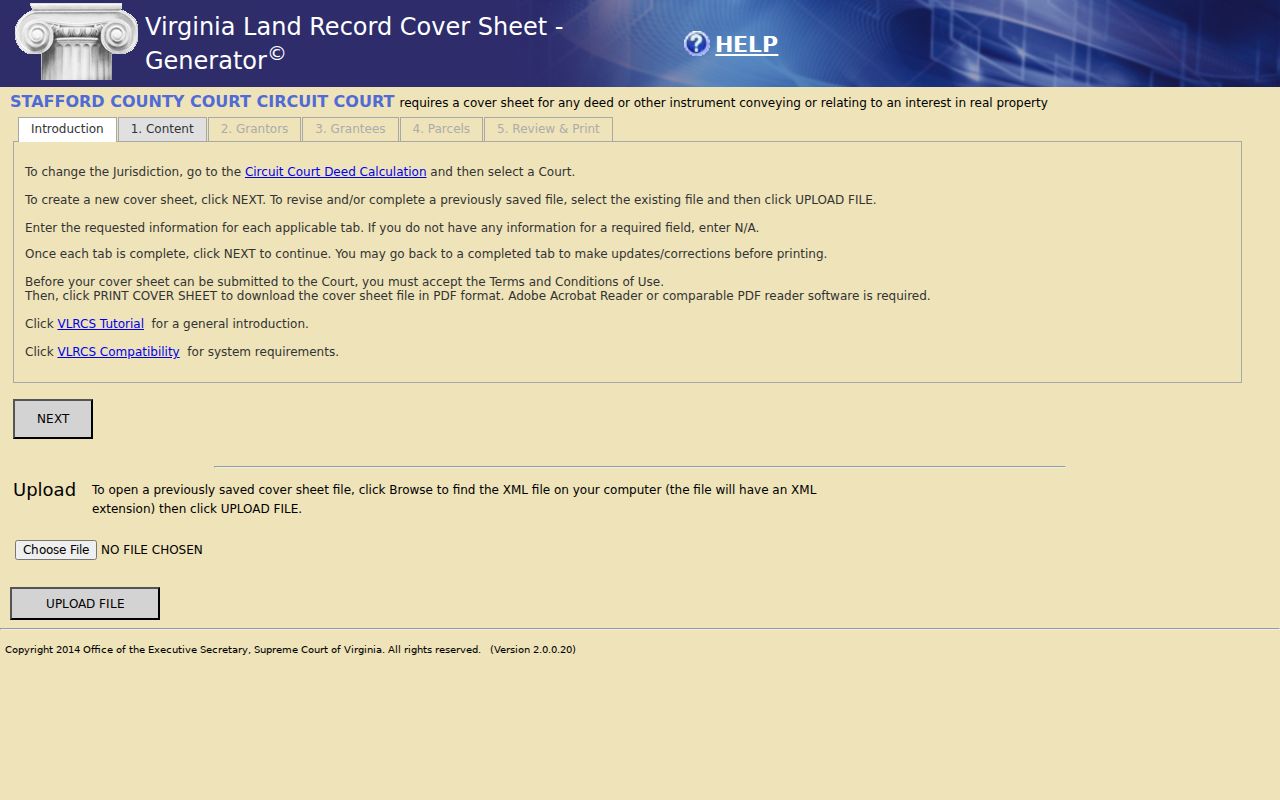
A map identifier and a legal description often appear together in a result. Keep both, so the filing can be checked against the assessor's records and the plat.
Grantors and Grantees in Stafford County
A grantor transfers an interest. A grantee receives it. The same person can be a grantee in one Stafford County deed and a grantor in the next. That succession of recorded instruments is the chain of title. Search by party and filing reference first. Then check each result against the legal description to confirm it concerns the same land in the deed records.
- Find the newest deed that describes the parcel and note its grantee and recording reference.
- Read the prior deed reference and the grantor named in that conveyance.
- Search that prior party as grantee, then compare the earlier legal description.
- Repeat until the index stops; ask the clerk or consult cataloged books for older records.
- Grantor
- The party that conveys or transfers the stated interest.
- Grantee
- The party that receives the stated interest.
- Chain of title
- The ordered sequence of recorded conveyances for the same land.
- Book and page
- A volume and page reference; an instrument number is another filing identifier.
Stafford Clerk Copies Have a Counter Route
An image sits behind a login. An older book is what you need. Or a certified copy is required. In any of those cases, the Stafford Circuit Court Clerk is the office to call. The clerk lists 1300 Courthouse Road, P.O. Box 69, Stafford, Virginia 22555, phone 540-658-8750, and fax 540-658-4653. Land Records has its own line, 540-658-8752. The public counter is open 8:00 a.m. to 4:00 p.m. Payments stop at 4 p.m. sharp. Call ahead if your request depends on a particular volume or copy process.
A solid request includes the grantor and grantee exactly as indexed. It also includes the recording date, the book/page or instrument number, the tax map, and the legal description. Decide up front whether you need a plain or certified copy. Confirm current fees with the office directly, since the clerk publishes no fee schedule online. An instrument number gets you a precise copy faster than an address search. Street names change over time, so this matters. The Stafford Circuit Court Clerk page is the official contact reference. It covers deed records and other filings.
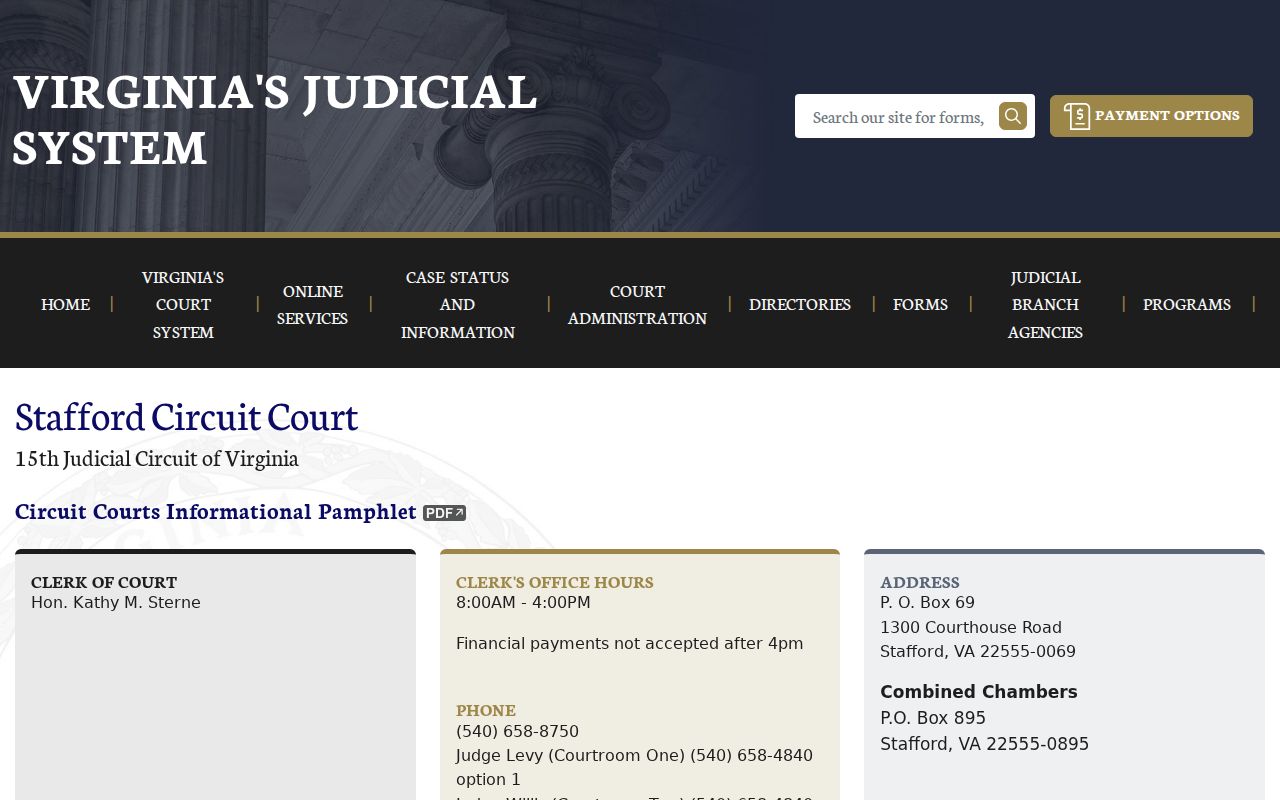
The counter is the right place to inspect land records or order a certified copy. It is not the place to ask the clerk for a legal opinion on title.
Stafford Deed Books Reach into Early Records
Stafford deed books reach back well beyond the modern electronic search window. The Library of Virginia catalogs early land books. The online SRA period does not cover them. Holdings include Deed Book 1722 through 1728. Liber Z covers 1699 through 1709, and Liber S spans 1780 through 1789. Liber P, dated 1754 through 1765, is legible only for 1754 through 1761. The catalog also flags Civil War losses from Union vandalism. So a missing volume may be a genuine gap rather than a failed search.
Catalog entries describe some books as originals, transcripts, or copies. That wording matters when you cite a historical chain. A transcript preserves a reading. But it is not the same object as the original instrument. The same catalog lists wills and estate accounts. These can explain a transfer when the last deed names a fiduciary. Ask the Library of Virginia about the reel or catalog item. Ask the local clerk about surviving books. Neither catalog range proves that every page is legible or complete. The Library of Virginia Stafford catalog identifies these historic land and will collections.
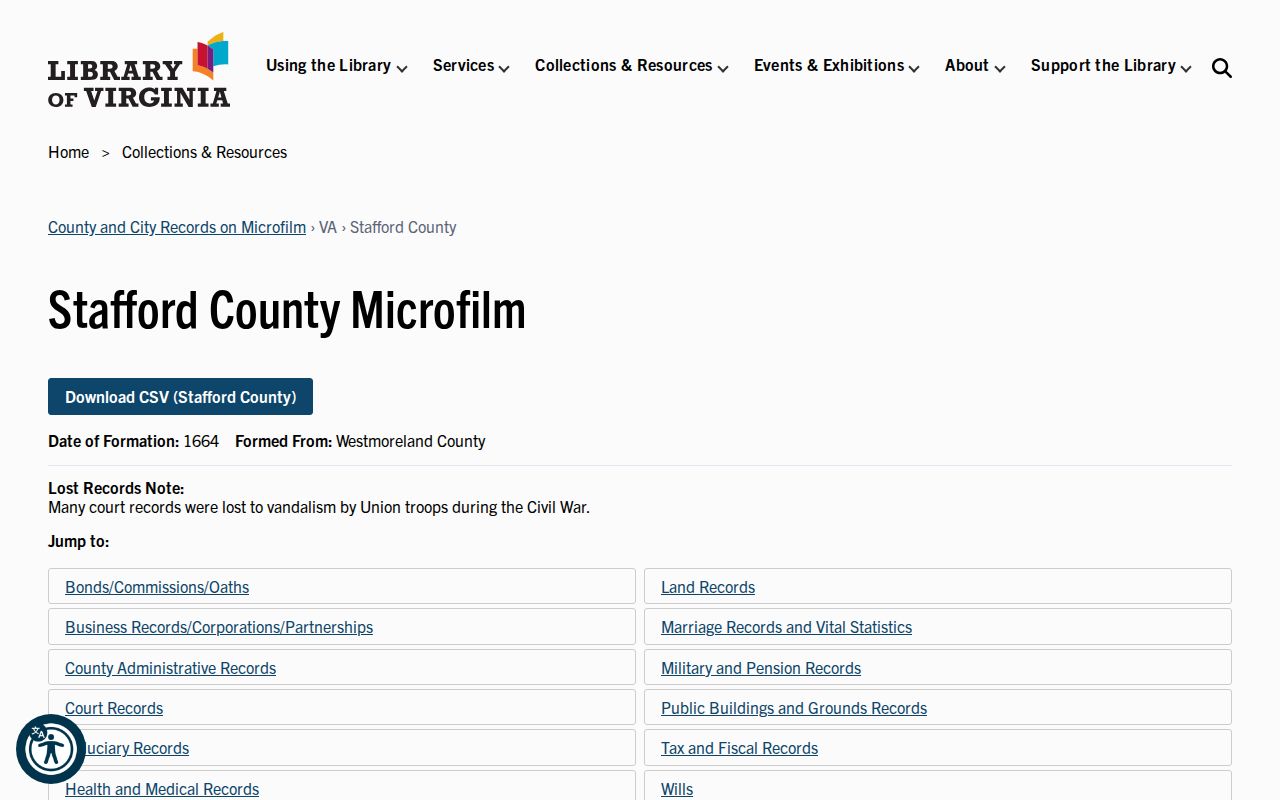
When a catalog entry says copy or transcript, carry that qualifier beside the date and reel in your citation. Presenting it as a complete original chain would overstate what the record is.
Stafford Deeds Need Release Checks
A deed of trust, judgment, lien, or other encumbrance can sit in the clerk's land records. Ordinary conveyances sit right beside it. The grantor-grantee index shows the parties and the instrument. One entry alone does not tell you whether the debt or claim is still open. Search separately for a release, satisfaction, cancellation, or later instrument that cites the earlier filing. Match the names, dates, and parcel description. A same-party entry may belong to another tract entirely.
For a property question, record the document type and recording date. Also note the book/page or number and any referenced prior instrument. A tax bill can reveal unpaid tax or payment history. But it does not replace the deed index for recorded liens. Even a careful deed search can miss an unrecorded interest, a name variant, or a filing outside the confirmed online range. If a result affects a purchase or an estate, ask the clerk for certified documents. Bring a title professional in for the chain review.
Request a Stafford County Deed Copy
Start with the SRA index to identify the instrument when that access is enabled. Then follow the image route provided for Stafford. If the image is unavailable, contact Land Records with the reference. Ask how to inspect or obtain the document. A paper request should include the parties and the date or approximate period. Add the instrument number or book/page, the tax map, and the legal description. Include a return address too. State plainly whether you need a certified copy. Confirm the current fee and payment method with the clerk. No amount is published online.
Older materials may call for a book, reel, or catalog request. Electronic images may not exist for them. The clerk's counter is the local fallback. The Library of Virginia catalog points to Stafford microfilm and surviving record groups. A public-record request under VFOIA is the wrong route for a clerk-held certified deed. Court clerks follow their own access procedure. A recorded deed shows only the instrument accepted for record. It does not show every possible interest in the land.
Recorded, not guaranteed. The index shows recorded instruments located under the search terms used. It does not rule out unrecorded interests, name variants, later filings, or gaps in historic books, and it is not a title opinion.