
Stafford County Property Tax Records by Field
Stafford County breaks its public tax sample into distinct fields. The parcel map and alternate PIN identify the land itself. The account number and bill number identify that tax transaction. That transaction is tied to the parcel. Assessment figures come next: land, improvement, abatement or land-use value, and the total. The rate follows. Annual tax, relief, net, and half-year amount follow. Those labels walk through a calculation. Collection has its own set of fields, covering payment, penalty, interest, and the due date. Read each label on its own. That habit keeps an assessment from being mistaken for a balance. It also keeps a balance from being mistaken for a sale price.
| Field | What It Shows | Where |
|---|---|---|
| Land, improvements, total | Assessment components carried into the tax calculation | Commissioner of the Revenue |
| Use-value or abatement | Adjustment that can reduce the taxable amount | Assessor record and Treasurer bill |
| Map #, alternate PIN, legal description | Parcel identifiers, including when a situs is absent | Assessor and Treasurer records |
| Rate, annual, net, half-year tax | How the charge is computed and split | Stafford County Treasurer bill |
| Due date, payment, penalty, interest | Collection status and the amount still due | Treasurer and county-linked ePay |
For a current balance, the Treasurer's bill is the right route. Aumentum is the route for assessment figures. Stafford reassesses real estate on a biennial cycle, and interim assessments cover new property. The latest verified baseline is January 1, 2024. Market conditions can still move between cycles. A bill amount may also reflect land-use assessment, relief, or payment timing, so the Stafford County property value page helps separate assessed, market, and sale figures.
Stafford County Revalues on a Biennial Cycle
The Commissioner of the Revenue's Real Estate Division handles biennial reassessments in house. It also handles interim assessments for new property. County budget material names January 1, 2024 as the latest verified reassessment baseline. That date is a reference point. It does not promise every parcel moved with the market. The roll does not update the moment a deed records. The county publishes no exact transfer-to-roll lag.
The Board sets the real-estate tax rate each April. Never carry a past year's rate forward. Qualifying agricultural, horticultural, or forest use can also lower a parcel's assessment under use-value rules. If the land later fails the use test, rollback taxes and interest may apply. A bill's amount depends on more than a headline number. Assessment, tax year, adopted rate, program adjustments, and payment status all feed the figure.
Stafford County Tax Bills Split in Two
The Treasurer bills real estate twice a year. The first half covers January 1 through June 30 and is due June 5. The second half covers July 1 through December 31 and falls due December 5. These are collection dates only. They say nothing about when an assessment was set or when a transfer reached the roll, so check the bill or the county's current tax page for the year-specific amount and any current notice.
The county's real-estate tax page is the official route for the current search and payment step, and a record may show a total, annual charge, net amount, second-half amount, and payment history. Match the billing period. Match the account number too. That keeps a payment from landing on the wrong parcel. Even when a statement never arrives, the county still expects the taxpayer to inquire about the account.
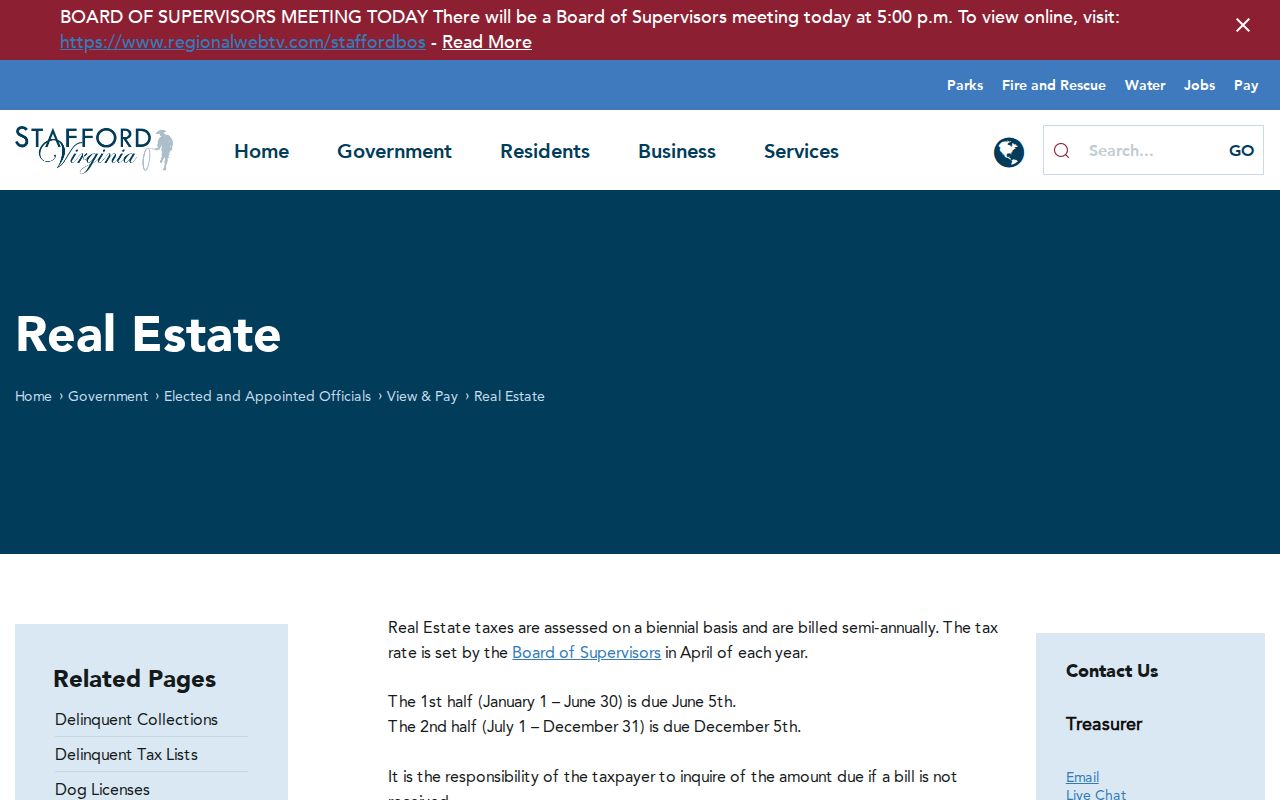
The county's real-estate tax page is the start. When you move to ePay, use the account identifier exactly as the live statement prints it.
Find a Stafford County Bill by Account
The Treasurer's real-estate page links to the county's ePay search. Start from Stafford's own site rather than a provider address. The live search form sits behind that county link. A provider's address may not stay the permanent entry point. Enter the account number exactly as printed. Keep the letters and dashes. Then compare the parcel map and alternate PIN against the assessor record. If no situs address appears, use the legal description. Use the map key to confirm which land the account covers.
- Open Stafford County's real-estate tax page and follow its ePay link.
- Enter the bill account as printed and compare the map and alternate PIN.
- Read the billing half, due date, tax components, payments, penalty, and interest.
- For a value or use-program question, contact the Commissioner rather than the Treasurer.
- Assessed value
- The county value used as an input to taxation.
- Use-value
- A lower qualifying assessment for certain agricultural, horticultural, or forest land.
- Abatement or relief
- An adjustment shown separately from the base assessment and charge.
- Tax lien
- A recorded claim related to unpaid tax, which should be confirmed in the proper land record.
Reach the ePay service reached from the county tax page when you need to search a Stafford County account or pay a bill.

The provider screen works for the bill transaction itself. The county page stays the safer starting link if the provider changes its route.
Stafford Use-Value Can Change the Bill
Stafford's ordinance allows use-value assessment. It covers qualifying agricultural, horticultural, and forest land. The tie is to qualifying use. It is not the price a parcel might bring in an open sale. If the use changes or stops qualifying, rollback taxes and interest can apply. That gap explains the taxable figure on a bill. It can differ from the assessor's land and improvement totals. The program is a valuation rule with a later tax consequence. It is not a deed or ownership record.
Stafford also describes tax relief for the elderly and disabled. Age, income, and net-worth tests apply. The benefit covers one dwelling and up to an acre. The Commissioner of the Revenue confirms current thresholds and application dates. A generic exemption list from another Virginia locality will not describe Stafford's rules. Ask which program and tax year appear on the specific parcel record.
The Stafford use-value ordinance explains the local land-use assessment framework.
Late Payments Need the Treasurer's Account
A tax bill is not always the final word. The amount can shift after the due date. The account tracks penalty, interest, total paid, and date paid. Read those fields instead of doing math from an older statement. A mortgage escrow payment can make the paper bill look out of step with the current account. So can one posted close to a deadline. When a payment is missing from the account, contact the Treasurer. Bring the account number, bill period, amount, payment date, and any confirmation detail.
Reach the Stafford County Treasurer at P.O. Box 68, Stafford, VA 22555-0068, or call 540-658-8700 with tax payment questions. The Treasurer publishes no stable delinquent-tax list online. An absent list does not mean a delinquency does not exist. Recorded tax liens and sale-related instruments are a different matter. Those live with the Circuit Court Clerk, the keeper of recorded land instruments. The Treasurer confirms the account balance.
Stafford County Assessment Search Fields
The assessor's advanced-query help lists fields that refine a parcel value search. Not every query mode is open to the public. It expressly offers no owner-name search. Use the form's visible filters to narrow the assessment record. Then keep the tax year and parcel key.
| Search field | What It Narrows | Use Note |
|---|---|---|
| Street, city, state, ZIP | Address or postal location | Postal label does not establish a separate city office |
| Situs, ParcelID | Location or assessor map key | Use the no-space format shown by QuickSearch |
| Property class, neighborhood | Assessment category or area label | Read as assessor data, not a legal boundary |
| Land type, acreage, land, improvements, total | Property characteristics and value ranges | Compare with the same year and parcel |
Appeal a Stafford County Assessment
Start with the tax year and the map-block-lot. Then compare the land, improvements, any abatement or land-use adjustment, and the total against the parcel facts and supported comparable assessment information. The Commissioner of the Revenue handles review questions. Call 540-658-4132, option 2. A Board of Equalization application asks for the owner, property description, map-block-lot, reason for the challenge, supporting evidence, signature, and requested hearing. Representatives face extra requirements. A representative must identify the signer and the relationship, list each property and tax year, and attach the owner's authorization on letterhead.
The available Stafford appeal PDF covers the 2024 cycle. It gives a June 5, 2024 postmark date. That deadline is historical and must not be reused as a current filing date. Its authorization instructions say the letter need not be notarized and does not continue forever. Ask the Commissioner for the current appeal window, filing route, and form before relying on an old packet. An appeal turns on fair market value, uniformity, or legality. A recent asking price alone will not carry it.
Appeal window. Contact the Commissioner of the Revenue for the current calendar. The June 5, 2024 date in the available Board of Equalization form belongs to that past cycle and is not a current deadline.